Tuesday, March 20, 2012

Hard lessons to Nitish Kumar regarding Nalanda University


Sanjay Paswan is trying to get a government job. A graduate in Hindi literature, he regularly appears for tests. But he might not get a government job because he has a criminal case against him.

The case against Sanjay, 32, is serious. He allegedly threw stones at Bihar Chief Minister Nitish Kumar three years ago when he was getting off a chopper with economist Amartya Sen and former president A.P.J. Abdul Kalam at a helipad in Nalanda. They were there to oversee preparations for the revival of the ancient Nalanda university. Sen and Kalam were the mentors of the proposed university, a dream project of the chief minister.

Sanjay was working as a construction labourer at the helipad. He and 17 other workers from the locality allegedly joined a group of people who threw stones at the chief minister when he landed on the property demarcated for the university. “The government snatched the land from us. They did not even pay the compensation we deserved,” said Sanjay.

Around 550 acres of fertile land was acquired from farmers, allege the villagers, against their wish. Each cottah of land (about 60 cottahs make an acre) was acquired at 110,000 on an average. The land transactions, however, have been stopped, as prices skyrocketed in the area. Now it is estimated to be around 150,000 a cottah, leaving the poor villagers who gave the land earlier in huge loss.
These people, ironically, appreciate what Nitish is doing in Bihar. Sanjay said he threw stones at Nitish on the spur of the moment. “I could not control myself when I saw the chief minister celebrating after kicking us in our belly,” he said. Ten cottahs of his land was acquired for the project. “Let us live without land. At least our state will change,” he said.

Soon after the incident the police raided many houses and arrested people who took part in the agitation. Sanjay was in jail for six months. He has pleaded to the chief minister to withdraw the case.
The project has left thousands of farmers in the five villages of Nalanda in a mess. Many have lost their land, their only source of income; some have lost their houses; schools had to be shifted; and burial grounds have disappeared. “We have heard that our region used to be a rich learning centre. We have to get our pride back. For that we are ready to do the sacrifice,” said Surendra Shaw, who lost his 20 cottahs of farmland to the acquisition. “I used to get three harvests a year,” he said. He will soon move out of his house and grocery shop.

Surendra got 12 lakh for the 20 cottahs, and 13 lakh as compensation for the house. At the current market price, he will not be able to buy anything worthwhile with the money. “My three sons have left the village to work as carpenters. I don't know how I would run my big family and buy a house with this amount,” he said.
Nalanda District Magistrate Sanjay Agarwal admitted that land prices were soaring in the region. But, he said, the government had paid the compensation according to the rules. “The fact is, after this phase of acquisition the compensation rate has been increased by the government manifold because of the sudden spurt of land prices in Nalanda. So in the next phase of acquisition the villagers would get better compensation,” he told THE WEEK.

Interestingly, the land acquisition in Nalanda was done around the same time the agitations against land acquisition in Singur and Nandigram in West Bengal shook the nation. The villagers said they could have raised their voice like the Bengal farmers but they chose not to. “It was easy for us to join the bandwagon. But we chose not to go the Bengal way as we thought Bihar would lose a great opportunity,” said Shivshankar Paswan, 40, a farmer. “It is true that none of us has given land wholeheartedly. But we did not have any violent protest.”
Though the villagers seem excited about regaining Nalanda's lost glory and the promised economic boom, most of them do not have any idea about the ancient Nalanda university. “To be honest, I have no idea what was taught there or who built it. But I have heard that if this project shapes up, hundreds of people would come and stay here. Many other institutions would also come up. We will have jobs,” said Shivshankar.

The project, in fact, could be a game changer. It is getting millions of dollars of funding from around the world. China has already invested $1 million. The proposed university, which is located about 8km from the ancient university site (where the Archaeological Survey of India has unearthed the ruins of the university and a monastery), will have centres for Buddhist studies, philosophy, comparative religion, history, international relations and peace studies. The university will also offer modern courses such as business management, public policy and development studies, environment and information technology.
A mentor group headed by Sen has created a roadmap for the institution. Though the disagreement among the mentors was apparent when Kalam opted out of the committee citing the absence of space science and nuclear science in the curriculum, the work is already underway. Expressions of interests have been sought from many agencies for the proposed design of the university and the progress is being directly monitored by the ministry of external affairs. “We are all set to begin our academic session in two years,” said Gopa Sabharwal, vice-chancellor of the university.
Nitish has been showing keen interest in the project from the beginning. “The chief minister arranged funds for it and invited foreign investment. But as foreign countries have decided to pour in big amounts, he decided to hand over the entire project to the Central government, as it has agencies to deal with the foreign funds. However, it remains his dream project,” said Agarwal. Though he denied that the state government wanted a say in building the university and deciding the curriculum, the authorities addressed Nitish's concerns at every step, especially after he successfully acquired the land.

To make his intentions clear, Nitish asked the administration to create awareness among the people of Nalanda in advance. The district magistrate camped in the area and the villagers were taught about the project. “Despite having no knowledge of the ancient Nalanda, the villagers could understand the importance of the project and how it could change their lives,” said a government official.
It helped. The Communist Party of India and the Rashtriya Janata Dal tried to incite the farmers against the project. But the villagers shied away from them. “We thwarted all such plans to damage the project. It is true that the government cheated us by paying very little compensation. But we never allowed political parties to agitate,” said Shyam Sunder Paswan of Pilkhi village.
Nitish visited Nalanda several times and met the villagers. He called the disgruntled villagers to the secretariat in batches and convinced them about the land acquisition. “Initially, some of us tried to create a committee against the land acquisition. But that committee was wound up as most of the farmers took compensation cheques,” said Shyam Sunder, who sold 13 cottahs for 18,000 each.
Agarwal admitted that without villagers' support the land acquisition could have been difficult. “It was remarkable that despite land protests across the country, we could do it in Bihar,” he said.

But it seems the goodwill has not been returned. Around 5,000 people have lost jobs because of the land acquisition. The youth have to go to other places for work. And, there is the looming threat of more acquisitions. But the government said it was just a matter of time that these people got jobs in Nalanda.
A medical college, five-stars hotels, engineering colleges, management institutes and English medium schools are coming up in Nalanda and the nearby tourist spot Rajgir. Roads are being widened and an airstrip is being built. All these, said Agarwal, would require huge manpower. So people would have to come back to join the development process.

But such promises are of no consolation for people like Surendra. “Could not the government show us some mercy by giving alternative land for housing at a low price?” he asked. He invited us for tea, saying with tears in his eyes: “You would be my last guests in this house.”

Read more:http://goo.gl/eJhgt

Friday, March 2, 2012

Filth, noise pollution shocks Costa Rica envoy-Nalanda University

Pilar Saborio de Rocafort, first ambassador of Costa Rica in UK, was in town. After her two-day visit to Nalanda, Bodh Gaya and Vaishali, she has all praise for good connectivity network in Bihar.

"This is my third visit to Bihar since 2001 and I can easily make out the changes made here in recent years," she told TOI here on Wednesday. But she was shocked to see the condition of the Ganga in the city.

"The Ganga has gone far away. Please do something to save her. During my earlier visit, it was very close to the city," Saborio, also an expert on environment issues, told TOI before leaving for Delhi.


The 52-year-old ambassador also holds a master of philosophy degree in development studies from the University of Cambridge, and she is currently working on her doctoral dissertation on 'The Transnational Networks of Latin American Elites' in Miami.

With her keen interest in nature, Saborio is the ideal person to promote her country's environmental policies in the UK. "With 96 percent of electricity generated by hydroelectric plants, the country is close to becoming the first voluntary carbon neutral country in Central America," she said.

"The ruins of Nalanda University is amazing. Bihar has a lot of potential to attract tourists from abroad. I was excited to see the holy relic of Lord Buddha during my visit to Patna Museum," she said.

But she was shocked to see the heaps of filth and noise pollution in the city. "With this amount of blaring horn and filth littered in the every nook and corner in the city, the quality of life has deteriorated," she said. "As a visitor, I strongly feel that personal hygiene is important for everybody's life."

The country now has 96 percent literacy rate. It is the combination of abolishing the Army, focusing on education, which has been compulsory and free since 1869.
Read more:http://goo.gl/XzQh1

Wednesday, February 29, 2012

Rich Heritage Memories of Bihar

Bihar, the very name still paints a picture of corruption and crime in our heads. All thanks to the infamous Laloo Prasad under whose leadership, this Indian state earned much of its bad name. And, while much has changed and improved with change in the state's leadership, it is unlikely Bihar will ever make it to different publication's list of places to see before you die, but Bihar surprised me, BIG time. It charmed me with its nothingness. Its vast empty lands brought me peace. It gave me a break that I needed. And, for these reasons and more, Bihar has made it to my list of places to visit second time, around.

Nalanda
Our first stop enroute to Bodh Gaya, Nalanda is historically known for being an important centre of learning for Buddhists. It has been said that Nalanda University during its heyday housed more than 10,000 students, a fact difficult to believe for today nothing much of the glorious university remains except for its red brick ruins. Nevertheless, Nalanda as seen in the morning is a sight to savour.

Distance: Approx. 24 hour bus ride from Kathmandu.

Note: The university site opens only after 9 so it is pointless to reach Nalanda in the wee hours of the morning. An entrance ticket is required, which shouldn't cost you more than IRs 10.

Breakfast: Puri and choley, at a roadside stall. IRs 30

Rajgir


Rajgir is about two hours away from the site of Nalanda University. The first capital of the Magadh Empire is famous for its hot springs. The main temple where the hot water springs flow is always crowded so unless you are religious or a history buff, there's nothing much to do and see here.

Note: When a Pujari/priest kindly offers you hot water and blesses you amidst all the chaos and crowd, know that they are looking to be paid for their kindness. Anything less than 10 bucks won't be accepted. So, unless you want to go around distributing your tens, refrain from accepting their paid kindness.

Lunch: Veg Thali IRs 60

Kushinagar
The place where Buddha attained Parinirwana or was laid to rest, Kushinagar is located in Uttar Pradesh (U.P). It is best to visit this place on your way back as it is close to the Sunauli border. Buddha's cremation site among other temples and vihars are what attracts many to this town. It is ten hours away from Varanasi.

Note: The road from Varanasi to Kushinagar is said to be a dangerous one, full of thieves. It's best not to stop unnecessarily in between.

Final Destination: Bodh Gaya
The main purpose behind my trip was to attend the 32nd Kalachakra, which many speculated was going to be the last one. Bodh Gaya, where Buddha is said to have attained his enlightenment was the venue. Never did I think, I would eat, pray, love, Elizabeth Gilbert style, in Bihar of all places, thankfully, unlike Ms Gilbert I didn't have to break a bank to do so.


Amidst all the chaos that comes with mass of people gathered at a single place, (over 3 lakh people attended the teachings) it was amazing to see how Bodh Gaya managed to remain serene. A visit to the 80 feet Buddha statue early in the morning is all you need to do to experience the beauty of this spiritual town. There are also many temples and vihars built by different Buddhist nations, similar to the ones in Lumbini. The Thai temple stands tall among all and bedazzles at night. Have a glass or two of tea near the road side dhaba; engage in a conversation while taking in the view.

To be honest, Bodh Gaya seemed like a mini Tibet, that moment. With a majority of the attendees being Tibetans, with shops selling Tibetan goods lined at every street corner, and with the latest Tibetan music blaring out from every DVD player, it was impossible not to feel so. There were more Tibetan dialects being spoken than I had ever heard in my lifetime. It was Shapta, Tingmo and Thukpa that was being served in all the hundred something make-shift restaurants that had opened right before the teachings were to begin. A feeling of nationalism and patriotism seemed to fill the air at Bodh Gaya. Maybe it was the power of mass assembly.

A more relaxed air set in with the sun down. Invitations to different concerts, dramas and discussions blared from speakers. Young, enthusiastic Tibetans and monks hurrying towards the venues was a common sight at night. From 'Waka Waka' to 'Kongpo dance', these concerts had something for everyone.

It is not difficult to see why today Kalachakra has become more than just attending another religious teaching for Tibetans. It has become a meeting point for the Tibetan diaspora spread the world over. It has become a perfect place for families and friends to reunite and most importantly reconnect with their roots. One publication rightly put it "Kalachakra is like an extended picnic." It is indeed. The two weeks flew by in a wink. I can say I ate. Ate whole heartedly. I prayed. Prayed with sincerity. And, I loved. Loved selflessly.

Best time to visit: November to February (Different monlams (prayer service) take place in the winter season)

W.O.A: Bargain, bargain. If they say 10, you say 5, and then they'll say 5.


Budget: IC 500 per day excluding accommodation costs. If you are adventurous, you can get your own tent, and get permission to camp in one of the monasteries. While some charge for borrowing their land, some will only charge you for water and bathroom facilities.

Bus Fare: Round bus trip will cost you around 5000 NRs.

Varanasi
Being a bigger town, Varanasi has more to offer. There are more places to see, and more activities up for grabs. Its prime gem, the Ganges sits beautifully, in all its glory despite all the amount of waste that gets dumped into it. Sitting by the banks of Ganges ushers in a sudden calmness; a feeling that can only be beaten by boating in it.

Don't forget: To try Varanasi's famous Paan and Benarasi Aloo Dum

Shop: For Benarasi Sarees and silk fabrics

Thailand gives USD 100,000 for Nalanda varsity revival project

Efforts to revive the Nalanda University got a major boost today with Thailand extending USD 100,000 to the project and pledging more funds from the Thai private sector. "The Government of Thailand has been delighted to present USD 100,000. One Thai company made an initial investment of USD 5000. I have informed the university vice chancellor that four other companies have followed suit," Thai Ambassador to India Pisan Manawapat told PTI here.

Thai Prime Minister Yingluck Shinawatra, during her recent visit to India, had, in fact, encouraged the Thai business companies here to donate for the project, said the varsity's vice chancellor Gopa Sabarwal. She said the Thai government has opened a special account for the Nalanda University and money has come in there. Piloted by the Ministry of External Affairs, the Nalanda University revival project has been gaining steam in the past few years with the enactment of a law to give the varsity a stand-alone status with special provisions. "We would like to remain engaged in our contribution in our support of the Nalanda University because we believe that this is a wonderful project to revive one of the oldest universities," the Thai Ambassador said. China had contributed USD 1 million last year to the Nalanda project in Bihar, where constructed work has been initiated with erection of boundary wall.

Friday, January 20, 2012

Grassroots heroes lead Bihar's rural revolution !!


Contemporary Bihar is not all about Nitish Kumar and Lalu Prasad. In recent times, the resurgent state has thrown up many unlikely heroes who have emerged as role models.

Bihar's resurgence begins at the grassroots level. For many years, villages in Bihar saw their youths migrating to other states in large numbers in search of livelihood. It was left to the minuscule minority of do-gooders to stay back and contribute their mite towards a silent agricultural revolution in the state.

Leading the pack of achievers are five young and doughty farmers from Darveshpura village from Nalanda district who recently created a new world record in paddy cultivation. Sumant Kumar had a bumper yield of 224 quintal per hectare which was enough to eclipse the world record set by a Chinese farm scientist Yuan Longping. Four of his friends from the same village - Krishna Kumar, Nitish Kumar, Ramanand Singh and Sanjay Kumar - also had extraordinary produce. So proud was the chief minister Nitish Kumar of the achievements of the young farmers from his home district that he not only felicitated them at their ancestral place but also asked them to motivate other peasants in the state.

These farmers had opted for an unconventional way of paddy plantation known as the System of Rice Intensification (SRI), which requires less water and seeds than the traditional methods but helps procure far greater quantities.

Interestingly, it was a Dalit woman Jyoti Manjhi from the Naxal-infested Gaya district who first popularised this technique in Bihar by cultivating paddy on the barren land and converted many villages in Fatehpur block of the district into a veritable rice bowl. She has since become a Janata Dal-United MLA, thanks to Nitish who offered her the party ticket in the last assembly elections because of her achievements in the field of agriculture.

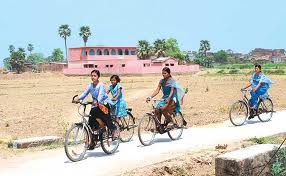
Manjhi is not the only woman who tilled her land to fame. Bihar has another role model in Rajkumari Devi, a woman farmer from Muzaffarpur district, who set up a self-help group of 360 underprivileged women to make them financially independent through farming alone. Her image of riding a bicycle through the dusty lanes of her village is the most enduring symbol of women's empowerment in a state known over the years for its feudal mindset.

Another farmer from Muzaffarpur district, 40-year-old Manoj Kumar too has become an icon for the youths of the state. He motivated the farmers in and around his Mustafaganj village to embrace organic farming and use vermi-compost on a large scale. A gold medallist in geography from Bihar University, Manoj has set up a band of about 350 farmers in his area who use latest farm techniques and grow two to three crops at the same time. Another remarkable aspect about Manoj's village is that the people plant ten saplings of Semal (silk cotton trees) to meet the expenses of the weddings of their daughters in future. This is, of course, akin to Dharhara village in Bhagalpur district where the villagers have, for long, been planting fruit trees on the birth of every girl.

It is because of these agrarian heroes living in the backwaters of Bihar that the state can hope for another green revolution in future. They may not be the familiar faces as yet but they are the ones who are working silently to make the most of Bihar's agricultural potential. In a state shunned by large investors and industrialists, they are the unsung heroes whose untiring efforts may ultimately lead to the revival of Bihar's crippled rural economy.


Devotion comes first for him

Richard Gere
Hollywood star Richard Gere.
Hollywood star Richard Gere kept everyone guessing about the place he had stayed during his recent visit to Bodh Gaya. He had gone there to take part in the Buddhist Kalachakra Puja presided by the Dalai Lama. He landed there on New Year's eve and listened to the Dalai Lama's discourse every day. He spent the rest of the day as a normal devotee without the trappings of a celebrity. He spent most of his time at different monasteries and visited the Mahabodhi temple. He apparently did not want the focus to be shifted away from the huge Budhhist congregation in any way.


The advent of multiplexes has sounded the death-knell for the single-screen theatres in Patna. Most of the old theatres have either shut down or are being demolished to make way for huge shopping malls. Two of the oldest cinema halls - Ashok and Elphinstone - have already been closed. But the oldest theatre in town Regent is holding its fort. Established in 1928, this cinema hall has reinvented itself to cater to the needs of the new generation of cine goers. It now has a coffee shop, offers online tickets and even keeps its lavatories clean. Hardly surprising then, it has retained its loyal clientele.

The 84-year-old theatre has also started giving away gifts to its patrons 'as a mark of reciprocation for their affection'. This year, 101 lucky winners will get surprise gifts every month. Of course, the ticket rates of this theatre are at par with a multiplex. It has stayed in business by taking advantage of the multiplex boom rather than getting swamped by it.


Bovine love unites Lalu and Nitish

Nitish Kumar
Bihar CM Nitish Kumar
Much has been written about Rashtriya Janata Dal president Lalu Prasad's love for his cattle.

He proudly kept his herd of cows and buffaloes at the chief ministerial bungalow, 1 Anne Marg, when his party called the shots in Bihar.

After being ousted from the power, he had to shift his 'bovine brigade' to his cattle farm at Danapur in the outskirts of Patna.

In contrast, nothing was known about the domestic animals that the incumbent chief minister Nitish Kumar kept.

It was only after he disclosed the details of his moveable and immovable assets that the people realised that he, too, had two cows with three calves worth Rs.83,000. A year ago, he had only one cow and a calf worth Rs.53,000 only.

===

Triple role for Patna's woman SP

Kim
2008-batch IPS officer Kim.
The Bihar police had last year decided to create three posts of City SP instead of one in the state capital in view of its burgeoning population.

Patna was subsequently divided into three zones and three young IPS officers were posted as City SPs under one Senior Superintendent of Police for effective policing in the city. But in less than a year, things are back to square one. Patna, at present, has only one City SP - a 2008-batch woman officer Kim who is also in charge of traffic. Two of her fellow City SPs - Shivdeep Lande and Upendra Sharma - have been shifted to other districts.

Since no replacements have come in their place so far, Kim remains the lone City SP. She is the first-ever woman IPS officer to become the City SP of Patna and her bosses in the department have apparently given her a chance to prove that she can handle the city's crime and traffic at the same time for which three officers were required earlier.


Read more: http://goo.gl/x1VX8

Tuesday, January 17, 2012

Pillars for Nalanda dream-Construction of boundary wall begins at varsity site


Chief minister Nitish Kumar’s dream to see Nalanda International University become operational has finally started to take concrete shape with the construction of the first pillars beginning recently.

A signboard at the construction site states that Rs 10.19 crore has been sanctioned for the boundary wall of the proposed university, which would come up on a 450-acre plot located on the eastern Rajgir-Chhabilapur Road in the district.

Bihar Rajya Pul Nirman Nigam Ltd, an undertaking of the state road construction department, has appointed Allied Infrastructure Pvt Ltd to construct the boundary wall. The construction work began on December 22, 2011, following the finalisation of the agreement on December 20.

Gopa Sabharwal, the vice-chancellor-designate of Nalanda International University, told The Telegraph over phone from Delhi that the architectural design of the new institution would be finalised by the end of this year.

“The ongoing construction (of the boundary wall) around the land earmarked for the university would be over within seven months, while the process to prepare the master plan would begin in three months. The master plan will take care of land usage for construction of academic and residential buildings as well as landscaping of the entire campus. Global tenders would be floated to select the agency. It would be entrusted with the task of making detailed building plans. The agency would get six months to chalk out the details.”

An official at the construction site said: “The boundary wall would stretch over 8.5km. We have plans to construct the boundary wall within seven months. The wall would be 2.5-m long and 4.5-inch wide. There will be two 10-inch beams, one below and another above the wall. There shall also be a piling every two metres,” the official overseeing the construction work said. About 90 labourers are at present working at the site.

Nalanda sub-divisional officer Seema Tripathi said more labourers would start work by the end of January. “The work will pick up pace once the temperature rises a little. Work would continue even at night. Since the temperature is very low now, the labourers are working only during the day,” she said.

Though Sabharwal was non-committal when academic activities would begin at the proposed university, she was specific about the schools that would be built in the first phase. “A school of historical studies and another of environment and ecology would be the first two institutions to be built in the first phase of academic activities of the university. The nature and structure of the schools, including course structure, specialisation, methodology of faculty selection and constitution of an advisory committee, are being worked out at present. Moreover, the process of faculty selection would be undertaken simultaneously with building construction process. The aim is to make the faculty ready for the schools by the time the building construction work was finalised,” the vice-chancellor designate of Nalanda International University said.
Read more: http://goo.gl/2GsgB

'Nalanda University will reintroduce soft power of India', says PM Modi in Rajgir

  Nalanda University History Situated in the ancient kingdom of Magadha (modern-day Bihar), Nalanda University was established in the fifth ...